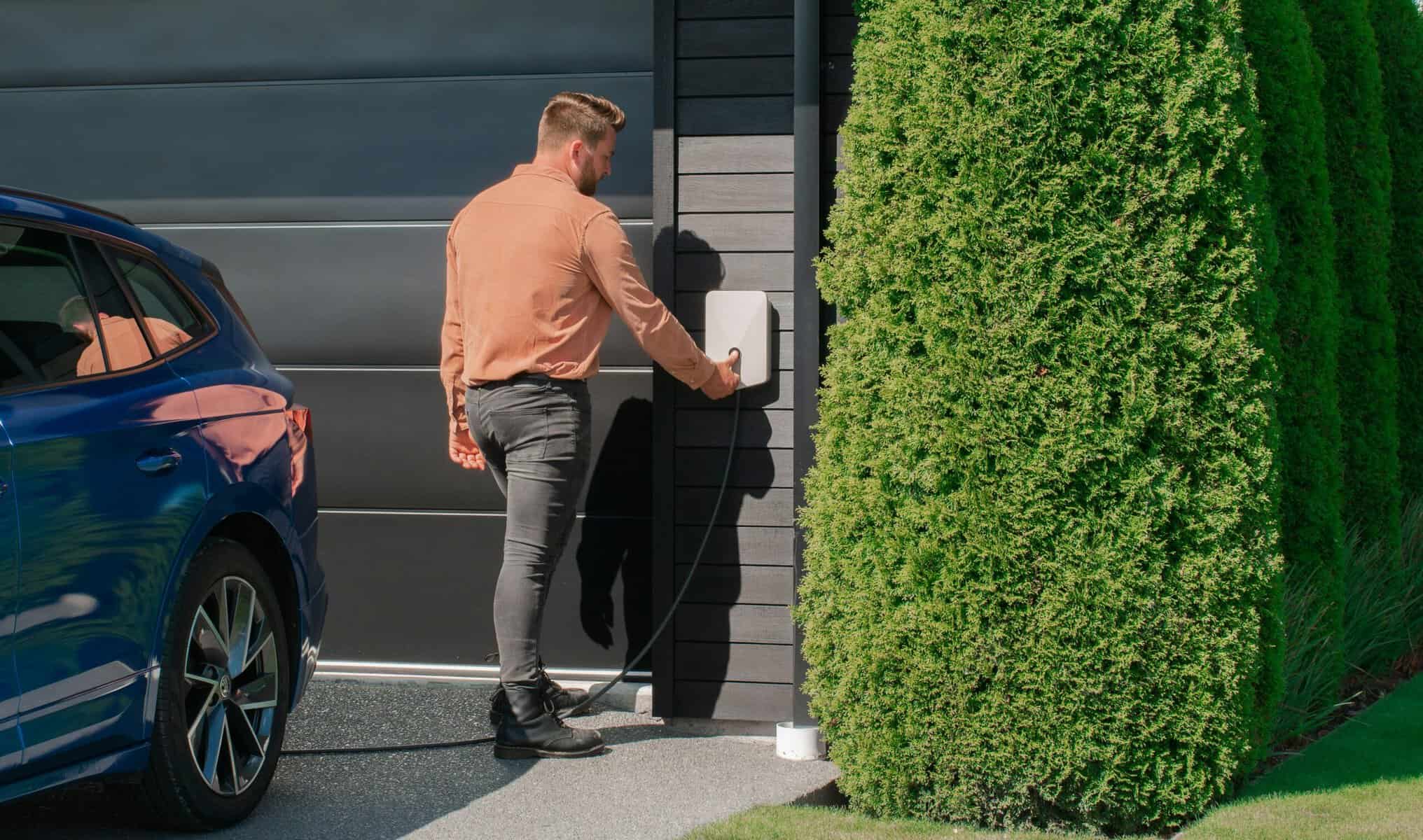
EV Charging with Solar Panels Australia 2026: Power Your Car for (Almost) Free
Electric vehicles and rooftop solar are a natural combination — and in Australia in 2026, they’re increasingly being treated as a single energy system rather than two separate purchases. The maths are compelling: the same solar panels that power your home during the day can also power your car at night, provided you have the right setup.
This guide explains exactly how EV charging with solar works in Australia, what equipment you need, how much you save, and whether adding a battery makes the economics even better.
The Core Opportunity
The average Australian electric vehicle uses approximately 15–20 kWh per 100 km. For a household driving 40 km per day — a typical commute — that’s roughly 6–8 kWh of electricity per day for the car.
At grid electricity rates of 30–40c/kWh, charging that EV from the grid costs $650–$1,100 per year. Charging it from rooftop solar instead costs close to zero — the electricity is generated on your roof and would otherwise be exported for 3–10c/kWh.
The annual saving from charging your EV with solar rather than grid power: $500–$1,000 per year for an average-use household.
How Solar EV Charging Actually Works
There are three main approaches, ranging from simple to sophisticated:
Approach 1 — Timed charging (simplest)
Programme your EV or home charger to charge during daylight hours — typically 9am to 3pm — when your solar panels are generating at maximum capacity.
This is the simplest approach and requires no special equipment beyond a standard EV charger. If your solar system generates more power than your home uses during the day, that surplus charges your car instead of being exported to the grid at the low feed-in tariff rate.
Best for: Households where someone is home during the day, or where the EV is parked at home during work hours.
Limitation: If you need the car during the day, you’re charging at night from the grid.
Approach 2 — Smart EV charger with solar integration
A smart charger monitors your home’s solar generation in real time and adjusts the charging rate to match your surplus solar output. When your panels are generating 5 kW and your home is using 2 kW, the smart charger uses the surplus 3 kW to charge the car — automatically, without any intervention.
Smart chargers that integrate with solar systems include brands like myenergi Zappi, Fronius Wattpilot, and various others compatible with Australian solar inverters.
Best for: Households that want to maximise solar self-consumption automatically without manually timing charging.
Cost: Smart chargers add $300–$800 to the cost of a standard EV charger installation.
Approach 3 — Solar + battery + EV charging
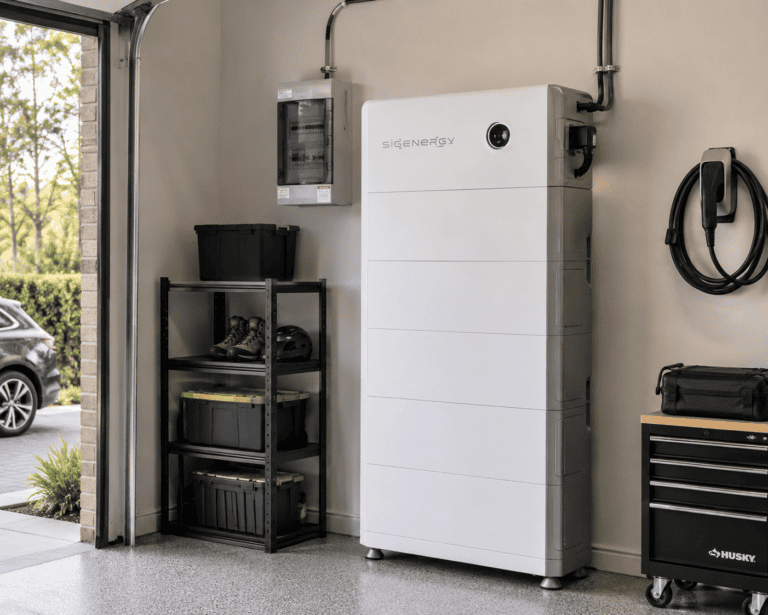
The most complete setup: solar panels charge a home battery during the day, and the battery powers the EV overnight. This is the true “charge from solar 24/7” scenario — the car charges from stored solar energy regardless of when it’s plugged in.
This setup requires a larger battery than a household without an EV — typically 15–20 kWh rather than 10 kWh — to cover both evening home use and overnight EV charging.
Best for: Households that want maximum energy independence and are prepared to invest in a larger battery system.
What EV Charger Do You Need?
Level 1 — Standard power point (2.4 kW)
Every EV comes with a cable that plugs into a standard 240V GPO. This delivers approximately 10–15 km of range per hour of charging.
Solar compatibility: Works fine but slow. A 6.6 kW solar system easily covers a 2.4 kW charge on a sunny day.
Best for: Low-mileage drivers who have all day to charge.
Level 2 — Dedicated home EV charger (7–11 kW)
A dedicated EV charger (also called EVSE) delivers 7–11 kW, giving 40–70 km of range per hour. This is the standard home charging setup for most Australian EV owners.
Solar compatibility: A 7 kW charger uses more power than a typical 6.6 kW solar system generates. To maximise solar coverage, use a smart charger that throttles to match actual solar surplus.
Installation cost: $800–$1,500 installed, including a licensed electrician.
Best for: Most Australian households — fast enough for daily use, compatible with solar optimisation.
Level 3 — DC fast charging (50 kW+)
DC fast chargers are commercial installations. They are not suitable for home use and not relevant for solar integration.
How Much Solar Do You Need to Charge an EV?
For an EV driven 40 km per day (6–8 kWh daily charging need):
| Solar system size | Daily generation (Sydney, autumn) | Covers EV charging? |
|---|---|---|
| 3 kW | ~11 kWh | Partially — after home use, surplus varies |
| 6.6 kW | ~25 kWh | Yes — comfortably after home use |
| 10 kW | ~38 kWh | Yes — with surplus for battery charging |
| 13 kW | ~50 kWh | Yes — significant surplus even in winter |
For most Australian households adding an EV to existing solar, a 6.6 kW system is adequate for light to moderate EV use. Heavy EV users (60+ km daily) benefit from upsizing to 10 kW or adding a battery.
The Battery Question for EV Owners
Adding a battery changes the EV charging economics significantly — but the battery needs to be sized to cover both your home’s evening load AND your EV charging needs.
Without battery: Your EV charges from solar during the day (if you’re home) or from the grid at night. You capture roughly 40–60% of your EV charging from solar.
With 10 kWh battery: The battery covers your home’s evening needs. Your EV still charges from the grid overnight unless you have surplus battery capacity. Solar EV charging capture rate: 50–70%.
With 15–20 kWh battery: The battery covers evening home use AND overnight EV charging. Solar EV charging capture rate: 80–95% — close to fully solar-powered motoring.
The federal Cheaper Home Batteries Program rebate applies to larger batteries — a 20 kWh battery receives approximately $5,400 in rebate value at May 2026 rates, making the economics of a larger battery more attractive than they were 12 months ago.
Vehicle-to-Home (V2H) and Vehicle-to-Grid (V2G) — The Next Step
Some newer EVs and chargers support V2H (Vehicle-to-Home) and V2G (Vehicle-to-Grid) — using the car’s battery to power your home or export to the grid.
V2H in Australia 2026: Available on a small number of EVs including Nissan Leaf, Mitsubishi Outlander PHEV, and some newer models. The EV battery (typically 40–80 kWh) is significantly larger than most home batteries, making it potentially very valuable as home storage.
V2G in Australia: Still emerging — a small number of trials underway. Not yet commercially available to most households.
Both technologies are worth factoring into your EV purchase decision if you’re buying now — future-proofing your setup could save significant battery investment costs down the track.
Real Savings Calculation — Example Household
Household: 3-bedroom home, Sydney, 6.6 kW solar, EV driven 50 km/day
Without solar EV charging:
- EV electricity cost at 32c/kWh: ~$950/year
- Home electricity bill: $800/year (after solar savings on home use)
- Total: $1,750/year
With solar EV charging (smart charger, daytime charging):
- EV electricity cost (80% solar): ~$190/year
- Home electricity bill: $650/year
- Total: $840/year
- Annual saving: ~$910/year
With solar + 15 kWh battery + EV charging:
- EV electricity cost (95% solar): ~$50/year
- Home electricity bill: $200/year
- Total: $250/year
- Annual saving vs baseline: ~$1,500/year
Practical Tips for Solar EV Charging in Australia
1. Check your switchboard before installing an EV charger. A licensed electrician must assess your switchboard before installing a Level 2 charger. Older switchboards (pre-2000) often need upgrading — factor this cost into your budget.
2. Use time-of-use tariffs strategically. Some retailers offer cheaper off-peak rates (typically 10pm–6am). If you can’t charge from solar during the day, overnight off-peak charging is the next best option.
3. Consider your EV charger placement. The charger needs to be within cable reach of where you park — typically in or adjacent to a garage. Plan the cable routing before installation to avoid expensive conduit runs.
4. Tell your electricity retailer you have an EV. Some retailers offer specific EV plans with discounted overnight rates or solar export incentives. Worth reviewing your plan when you get the car.
5. Size your solar system for the EV from day one. If you’re installing solar and know you’re getting an EV within 2–3 years, size the system for both now. Adding extra panels later costs significantly more per panel than including them in the original install.
Frequently Asked Questions
Can any EV charge from solar? Yes — all EVs can charge from solar electricity. The difference is whether you have smart charging equipment that automatically matches the solar generation rate, or whether you manually time your charging.
Will solar EV charging void my EV warranty? No. Solar electricity is standard AC electricity — your EV doesn’t know or care where it comes from.
How do I know if my charger is using solar power? A smart charger or solar monitoring app will show you real-time data. Without smart monitoring, you can infer it: if your car is charging during the day and your solar system is generating more than your home is using, the surplus is going to the car.
Does EV charging affect my feed-in tariff? Yes — in a good way. Every kWh your EV uses from solar is a kWh you don’t export at the low feed-in rate. You’re effectively “selling” your solar to your car at the grid import rate (30–40c/kWh) rather than to the retailer at the feed-in rate (3–10c/kWh).
What’s the best EV for solar integration in Australia? Most EVs work equally well with solar. The key differentiator is V2H/V2G capability for future-proofing. Current V2H-capable models in Australia include Nissan Leaf and Mitsubishi Outlander PHEV — check the latest specifications before purchasing as this space is evolving rapidly.
Costs and savings estimates reflect the Australian market as at September 2026. EV electricity consumption varies by model, driving conditions, and climate. Always obtain multiple quotes for solar and EV charger installations.