How Many Solar Panels Do I Need? Calculator for Australian Homes 2026
The most common question Australian homeowners ask before getting solar quotes is: how many panels do I actually need? The answer isn’t one-size-fits-all — it depends on your electricity usage, your roof, and what you’re trying to achieve.
This guide gives you a simple calculation method you can run using your electricity bill right now, plus real-world recommendations by household size and state.
The Simple Method: Three Steps
Step 1 — Find your daily electricity usage
Look at your electricity bill. Find your average daily consumption in kilowatt-hours (kWh). It’s usually on the first page labelled “daily average” or “average daily usage.” If your bill shows totals rather than daily averages, divide the total by the number of days in the billing period.
Typical daily usage by household size:
| Household | Typical daily usage |
|---|---|
| 1–2 person unit/small home | 8–14 kWh |
| 2–3 person home | 14–20 kWh |
| 3–4 person home | 20–28 kWh |
| 4–5 person home | 28–40 kWh |
| Large home / pool / EV | 40 kWh+ |
Step 2 — Apply your location’s peak sun hours
Australia has four STC zones that reflect how much sun different regions receive. More sun means more electricity per panel.
| Location | Peak sun hours/day |
|---|---|
| Darwin, far north QLD | 5.5–6.0 |
| Brisbane, Perth | 4.8–5.5 |
| Sydney, Adelaide | 4.2–4.8 |
| Melbourne, Canberra | 3.8–4.2 |
| Hobart, alpine areas | 3.2–3.8 |
Step 3 — Calculate system size
Formula: Daily usage ÷ peak sun hours × 1.25 (efficiency factor) = system size in kW
Example — 3-bedroom home in Sydney using 22 kWh/day: 22 ÷ 4.5 × 1.25 = 6.1 kW → round up to a 6.6 kW system
Example — 4-bedroom home in Brisbane using 28 kWh/day: 28 ÷ 5.0 × 1.25 = 7.0 kW → 6.6–8 kW system
Example — 2-person unit in Melbourne using 12 kWh/day: 12 ÷ 4.0 × 1.25 = 3.75 kW → 4–5 kW system
The 1.25 efficiency factor accounts for real-world losses — inverter efficiency, cable losses, dust, temperature effects, and panel degradation. A system rated at 6.6 kW doesn’t generate 6.6 kW all the time.
Why 6.6 kW Is the Most Popular Answer
If you’ve been getting solar quotes, you’ve probably noticed that 6.6 kW keeps appearing as the recommendation. There’s a specific technical reason for this.
Most Australian homes have a single-phase electricity connection, which supports a maximum of 5 kW inverter capacity. However, the Clean Energy Council allows solar panels to be oversized by up to 33% relative to the inverter — meaning a 5 kW inverter can legally support up to 6.6 kW of panels.
Installers maximise this because more panels means more generation, better payback, and a more useful system — for no additional inverter cost. It’s genuinely the sweet spot for most 3–4 bedroom Australian homes.
Quick Reference: Recommended System Size by Household
| Household type | Daily usage | Recommended system | Typical panels needed |
|---|---|---|---|
| 1–2 person, low use | 8–12 kWh | 3–4 kW | 7–9 panels (440W) |
| 2–3 person, average | 14–18 kWh | 5–6.6 kW | 11–15 panels |
| 3–4 person, typical | 20–26 kWh | 6.6 kW | 15 panels |
| 3–4 person, high use | 26–32 kWh | 8–10 kW | 18–23 panels |
| Large home / pool | 35–45 kWh | 10–13 kW | 23–30 panels |
| Large home + EV | 45 kWh+ | 13–20 kW | 30+ panels |
Note: Panel count assumes modern 440–445W panels. Older or smaller panels require more panels for the same system size.
How Many Panels Fit on My Roof?
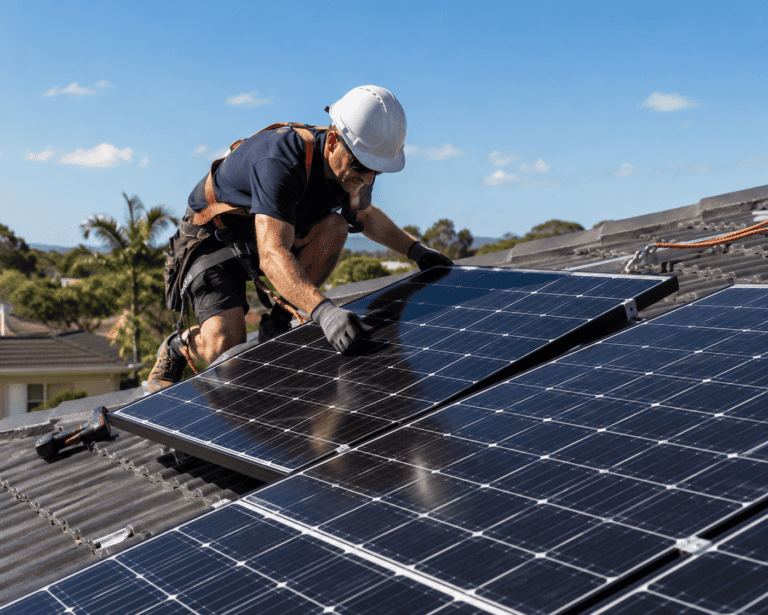
The number of panels that will fit depends on your roof size, orientation, and any shading from chimneys, skylights, or neighbouring structures.
A standard 440W solar panel is approximately 1.8m × 1.1m — about 2 square metres each.
Panel count by roof area (north-facing, no shading):
| Roof area available | Max panels (440W) | Max system size |
|---|---|---|
| 20 m² | ~9 panels | ~4 kW |
| 30 m² | ~14 panels | ~6.2 kW |
| 35 m² | ~16 panels | ~7 kW |
| 45 m² | ~20 panels | ~9 kW |
| 60 m² | ~27 panels | ~12 kW |
If your available roof space is limited, higher-efficiency panels (N-type TOPCon or HJT) generate more power per square metre — worth considering if roof space is constraining your system size.
Orientation and Shading — What Really Matters
North-facing is ideal in Australia — north-facing panels receive the most direct sun throughout the day and generate the most electricity annually.
East and west-facing panels generate approximately 15–20% less than north-facing. They’re worth installing if you have limited north-facing space, and can actually be advantageous if you consume most of your power in the mornings (east) or evenings (west).
South-facing panels generate significantly less and are generally only worthwhile as a last resort when all other roof space is exhausted.
Shading is the biggest performance killer. Even partial shading of one panel can reduce output across the whole string significantly, depending on your inverter type. Before installation, have your installer assess:
- Trees (and their future growth)
- Neighbouring buildings
- Chimneys, TV antennas, satellite dishes
- Dormer windows or skylights
If shading is unavoidable, microinverters or DC optimisers can mitigate its impact by allowing each panel to operate independently.
Should You Install More Than You Need?
A common question: should I oversize my system to allow for future needs?
Yes, if:
- You’re planning to buy an electric vehicle in the next 2–3 years
- You’re considering adding a battery within 5 years
- You have a pool or spa you’re considering electrifying
- You work from home and expect your consumption to stay high
The oversizing argument: Installing a 10 kW system when your current needs suggest 6.6 kW costs more upfront but locks in more capacity at the current (lower) STC rebate rate and avoids a more expensive retrofit later.
The constraint: Your network operator limits how much solar can be connected to a standard single-phase connection — typically 10 kW of panels maximum without special approval. Three-phase connections can support larger systems.
Does More Panels Always Mean More Savings?
Not always. The principle of diminishing returns applies to solar sizing.
Your first 6–8 kW of panels displaces expensive grid electricity with free solar. The next 2–4 kW beyond that generates surplus electricity that gets exported at the low feed-in tariff — which is much less valuable.
The sweet spot is a system sized to roughly match your daytime consumption plus enough surplus to meaningfully charge a battery (if you have one) or cover your evening use after export. Beyond that, additional panels add cost without proportional financial return.
Exception: If you’re adding an EV or planning significant consumption increases, bigger is better — you want the system sized for your future use, not just today’s.
Getting Accurate Quotes
When you’re ready to get quotes, give installers the following information to get accurate recommendations:
- Your last 12 months of electricity bills (or your annual kWh consumption)
- Your roof orientation and approximate usable area
- Any shading issues you’re aware of
- Whether you’re considering adding an EV or battery in future
- Your goals — maximum savings, maximum self-sufficiency, or specific bill reduction target
A reputable installer will provide a written proposal showing expected annual generation, estimated annual savings, and payback period based on your specific usage data.
Frequently Asked Questions
How many panels for a 6.6 kW system? Using modern 440–445W panels: 15 panels. Using older 370W panels: 18 panels. The number varies by panel wattage.
Can I install solar on a flat roof? Yes — flat or low-pitch roofs use tilt frames to angle panels optimally toward the north. This adds some cost but is a common and effective solution.
Does it matter which direction my house faces? The house direction doesn’t matter — what matters is which roof faces are available and their orientation. Many homes have usable north and east or west-facing roof space even if the front of the house faces south.
Can I add more panels to an existing system? Yes, but it depends on your inverter capacity and your network operator’s connection limit. Adding panels to an existing system (called a “retrofit expansion”) is more expensive per panel than including them in the original installation.
What’s the minimum system worth installing? Generally, systems below 3 kW offer limited savings for most households and have a longer payback period. If your roof space or budget only supports a small system, it’s worth considering whether waiting to do a larger installation makes more financial sense.
System size recommendations are based on typical Australian household electricity consumption and 2026 panel specifications. Your optimal system size depends on your specific roof, consumption, location, and goals. Always obtain a site-specific assessment from an SAA-accredited installer.