Solar Hot Water System Price Australia 2026: Costs, Rebates and Payback
The typical solar hot water system price in Australia in 2026 is about $3,000–$8,000 installed, before rebates. Most households land in the middle of that range – roughly $4,000–$6,000 for a standard 250–315 litre system with a straightforward install. After federal small-scale technology certificates (STCs) – and, in Victoria, the Solar Homes hot water rebate – the amount you actually pay can be noticeably lower.
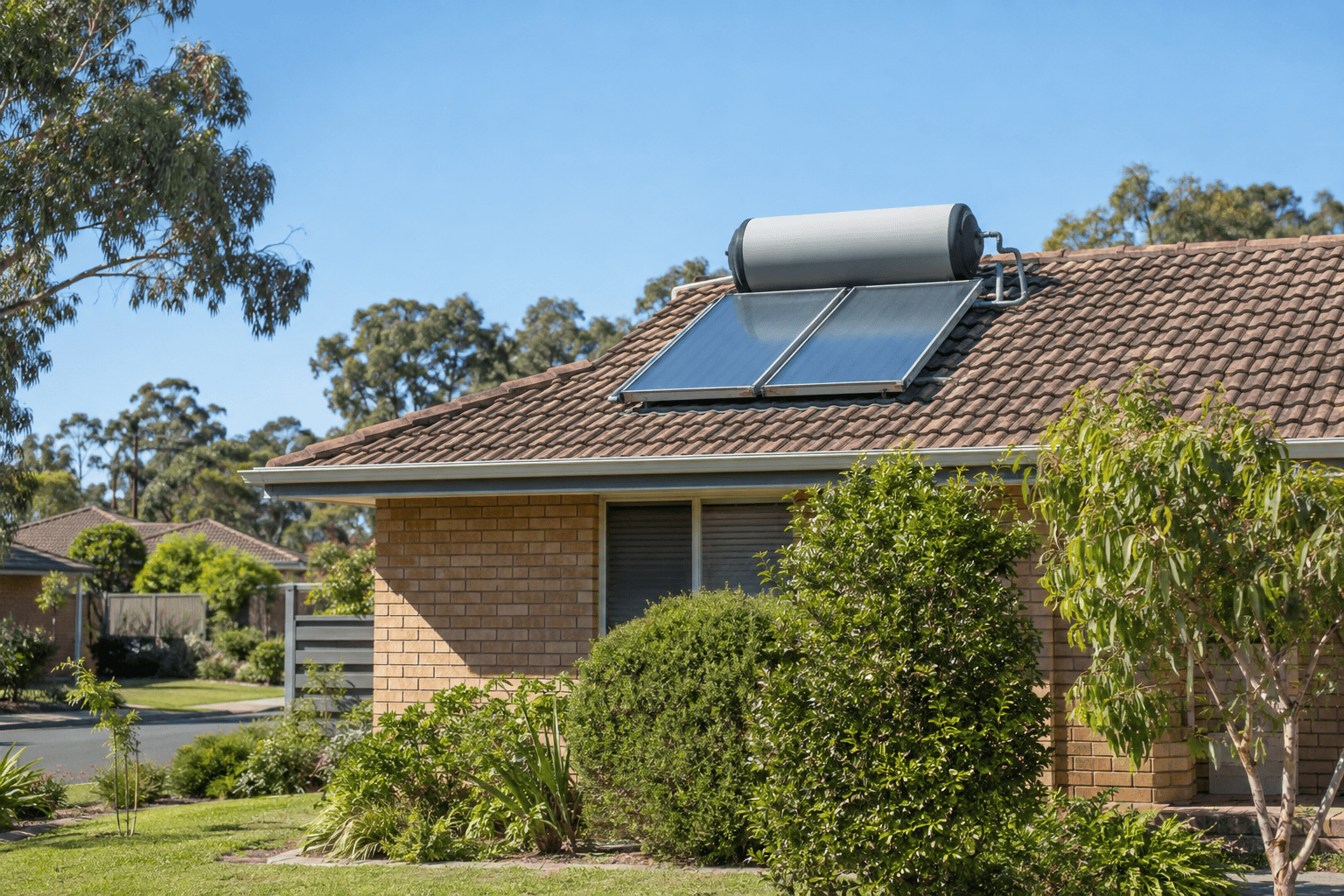
This guide covers what drives the price, which rebates you can realistically claim, what a system costs to run and how long it takes to pay for itself. It is about roof-mounted solar thermal systems – collectors on the roof heating water in a storage tank. If you are weighing that against a heat pump, our solar hot water vs heat pump comparison covers that decision in detail.
How Much Does a Solar Hot Water System Cost in Australia?
Published price guides and supplier quotes in 2026 put the solar hot water system price – for a fully installed system with tank, collectors, booster and a standard installation – at roughly the figures below. They are before any rebates and include GST.
| System type | Typical installed cost (before rebates) | Best suited to |
|---|---|---|
| Roof-mounted (close-coupled) flat plate | $3,800–$5,400+ | Sunny climates and roofs that can carry a full tank |
| Split system (tank at ground level) | $3,900–$6,000+ | Weaker roof structures, or where a roof-top tank is not wanted |
| Evacuated tube | Towards the top of the $3,000–$8,000 range | Cooler or cloudier regions where higher efficiency matters |
Treat these as ballpark figures, not quotes. A 160 L system for a small household costs less than a 400 L system for a large one, and the same system can cost noticeably more on a steep, two-storey roof than on a single-storey home with easy access.
What Affects the Solar Hot Water System Price?
Two quotes for apparently similar systems can differ by thousands of dollars. The usual reasons:
- Tank size – 250–315 L suits most family households; bigger tanks and more collectors cost more.
- System type – close-coupled, split or evacuated tube (see the table above).
- Boosting – every solar hot water system needs a backup for cloudy spells, either an electric element or gas. Gas boosting suits homes with a gas connection, although Victoria is moving existing homes off gas hot water as systems reach end of life (see below).
- Roof and access – pitch, height, number of storeys, shading and structural strength all change labour and materials. A full 300 L tank adds well over 300 kg to a roof.
- Plumbing and electrical work – longer pipe runs, switchboard changes, a tempering valve (a safety device that limits tap temperature) and removal of the old system are often itemised separately.
- Brand and warranty – tank, collector and labour warranties differ, and longer cover usually costs more up front.
- Location – regional installs can cost more once travel is added.
Rebates That Reduce the Price
Federal STCs (all states)
The Small-scale Renewable Energy Scheme is the national incentive. Eligible solar water heaters earn small-scale technology certificates (STCs), and your installer typically passes the value on as a discount on your invoice. To qualify, the exact model must be on the Clean Energy Regulator’s register of solar water heaters (domestic systems are those under 700 L) and it must be installed exactly as listed. If a component is missed or changed during installation, the system may not qualify.
How many certificates you get depends on the model and where you live (your STC zone), and the dollar value moves with the certificate market. For solar hot water, the STC discount commonly takes a few hundred dollars to around $1,000 or more off the solar hot water system price. The practical advice: ask every installer to quote the price after STCs, and to confirm the model is on the register.
Victoria: the Solar Homes hot water rebate
Victoria is the one state where a clear state rebate applies to solar hot water. As at November 2026, Solar Victoria offers a rebate of 50% of the purchase price, capped at $1,000 – or up to $1,400 for eligible locally made products. It is calculated after STCs and any Victorian Energy Efficiency Certificates have been taken off. The published eligibility rules include:
- You are an owner-occupier of an existing property, not a new build.
- The combined household taxable income of all owners is under $150,000 a year.
- The property is worth under $3 million and has not already received a Solar Homes hot water or battery rebate.
- The system being replaced is at least three years old.
- You use an authorised hot water retailer and a product from Solar Victoria’s eligible list.
At the time of writing, Solar Victoria’s locally made list includes electric-boosted solar models from Dux, Rheem and Solahart. Solar Victoria also says that, combined with a Victorian Energy Upgrades discount, upfront costs can fall by up to $1,630 – or $1,960 for a locally made system – although which VEU discount applies depends on the product and what it replaces (see Victorian Energy Upgrades hot water discounts). Also worth knowing: from 1 March 2027, existing Victorian homes must replace gas hot water systems that reach end of life with an efficient electric alternative such as a heat pump.
NSW, South Australia, the ACT and elsewhere
Other states and territories run their own hot water incentives, but the ones we reviewed for NSW (the Hot Water Upgrade Incentive under the Energy Savings Scheme), South Australia (REPS) and the ACT are aimed at heat pump water heaters rather than solar thermal systems. Programs and amounts change often, so do not assume a solar hot water system qualifies – ask your installer which incentives apply to your exact model and address before you sign.
What Will You Actually Pay? Two Worked Examples
These examples use illustrative numbers – your quotes will differ – but they show how rebates change the final solar hot water system price.
| Example A: no state rebate | Example B: Victoria, eligible household | |
|---|---|---|
| Installed price before rebates | $5,000 | $5,000 |
| Less STCs (illustrative) | −$900 | −$900 |
| Price after STCs | $4,100 | $4,100 |
| Less Solar Homes rebate (50% of price, capped at $1,000) | Not available | −$1,000 |
| Estimated out-of-pocket cost | $4,100 | $3,100 |
Example B assumes you meet every eligibility rule and ignores any Victorian Energy Upgrades discount. In both cases the STC figure is illustrative: the real number depends on your model and zone, so ask each installer for the after-STC price in writing.
Running Costs and Payback
Heating water accounts for around 15–30% of household energy use, according to Solar Victoria, which makes it one of the bigger levers on a power bill. A solar hot water system supplies much of that energy from the sun and uses its electric or gas booster only when it has to. Commonly quoted running costs for a typical household are roughly $150–$350 a year for a solar-boosted system, against around $500–$1,200 a year or more for a standard electric storage tank. The gap depends on household size, climate, how well the system is sited and your electricity tariff – our guide to the best electricity plan for solar owners explains how much the plan itself matters.
Here is a rough payback sum. Say a solar system costs $4,100 after STCs, while a plain electric tank would have cost $1,500 to replace. That is about $2,600 extra up front. If the electric tank would have cost $800 a year to run and the solar system $350, you save around $450 a year – a payback of just under six years, before any rebate beyond STCs. Replacing gas rather than electric usually saves less. If you are already on cheap off-peak power, or heat water with spare rooftop solar, savings are smaller and payback is longer. A commonly quoted range is roughly four to seven years when replacing an electric system.
Is Solar Hot Water Worth It in 2026?
It depends on three things: your climate, your roof and what you are replacing. In sunny, warm regions with a north-facing, unshaded roof, a solar thermal system can supply most of your hot water. In cooler climates, on shaded or awkward roofs, or where your state offers larger incentives for heat pumps, a heat pump often comes out ahead on net cost and flexibility. If you already have rooftop solar panels, a heat pump running on a midday timer is another way to use your own generation. We put the two head to head in our solar hot water vs heat pump comparison.
How to Get a Fair Solar Hot Water System Price
- Get at least three itemised written quotes and ask each to show the price before and after STCs.
- Check the exact model on the Clean Energy Regulator’s register – it must be listed to earn STCs.
- Ask what is included: removal of the old system, tempering valve, electrical or gas work, roof flashing and any structural work.
- Compare warranties on the tank, collectors and labour, not just the headline price.
- Check orientation and shading – north-facing, unshaded roof space matters in Australia.
- In Victoria, confirm the retailer is authorised, and avoid accepting a quote or paying a deposit before Solar Victoria confirms your eligibility. If you do pay a deposit, make sure it is fully refundable.
Frequently Asked Questions
How much does a solar hot water system cost in Australia?
Most are quoted at roughly $3,000–$8,000 installed before rebates, with many households paying around $4,000–$6,000 for a standard 250–315 L system. After federal STCs, and a state rebate where one applies, the amount you pay is lower.
Is there a rebate for solar hot water?
Yes. Eligible systems earn federal small-scale technology certificates (STCs) in every state, which your installer usually applies as a discount. Victoria also offers a Solar Homes hot water rebate of up to $1,000, or up to $1,400 for eligible locally made products, for households that meet its eligibility rules.
How long does a solar hot water system last?
Systems commonly last around 10 to 15 years, though lifespan and warranty terms vary by brand, water quality and maintenance. Check the tank, collector and labour warranties on your quote.
Does solar hot water work on cloudy days and in winter?
Yes, but the sun supplies less. Every system has an electric or gas booster that tops up the temperature when solar heating is not enough, which is why running costs rise in cooler, cloudier months.
Is solar hot water cheaper to run than a heat pump?
Not necessarily. Both cost far less to run than a standard electric tank. Solar thermal can be very cheap in sunny regions, while a heat pump often performs more consistently in cooler climates. The better choice depends on your climate, roof and available incentives.
Prices, rebates and eligibility reflect information published by the Clean Energy Regulator, Solar Victoria and Australian suppliers as at November 2026, and they change regularly. Figures are typical ranges, not quotes. Always obtain multiple written quotes and confirm current eligibility before you buy.