Is Solar Still Worth It in Australia in 2026? Honest Payback Calculations
Yes — for most Australian homeowners, solar is still worth it in 2026. But the way it works has changed significantly, and whether it makes sense for your specific situation depends on factors that generic answers tend to gloss over.
This guide gives you real numbers, state-by-state payback calculations, and an honest look at when solar might not be worth it.
What Has Changed in 2026
The economics of solar have shifted in two important ways:
Feed-in tariffs have fallen sharply. A decade ago, some Australian households earned 44–66c/kWh for electricity exported to the grid. Today, most states pay 3–10c/kWh. This means the old model of “export as much as possible” is dead. The new model is self-consumption — using your own solar power directly instead of buying from the grid.
Grid electricity prices have risen sharply. Most Australians now pay 30–45c/kWh for power from the grid. This is actually good news for solar owners — every kilowatt-hour you generate and use yourself saves you the full retail rate, which is now higher than ever.
The net effect: solar is still very much worth it. The return just comes from a different place than it used to.
The Core Maths — Why Solar Still Works
The fundamental equation is straightforward:
- You pay approximately 35c/kWh to buy electricity from the grid
- You earn approximately 6c/kWh for electricity you export to the grid
- Every kWh of solar you use yourself is therefore worth 6x more than every kWh you export
This means the key to getting value from solar in 2026 is maximising what you use directly — running your dishwasher, washing machine, pool pump, and other appliances during daylight hours, and considering battery storage to capture surplus energy for evening use.
A well-designed system with reasonable self-consumption can save a typical household $1,500–$2,500 per year.
Real Payback Numbers by State
A typical 6.6kW system costs $5,000–$8,500 after rebates, saves around $1,500 per year, and pays for itself in 3–6 years depending on your state and energy usage. Here’s how the numbers break down by state:
| State | Avg system cost (after rebates) | Est. annual savings | Payback period |
|---|---|---|---|
| NSW | $5,500–$7,500 | $1,400–$2,000 | 3–5 years |
| VIC | $5,500–$7,500 | $1,300–$1,900 | 4–5.5 years |
| QLD | $5,000–$7,000 | $1,500–$2,200 | 3–4.5 years |
| SA | $5,500–$7,500 | $1,800–$2,500 | 3–4 years |
| WA | $5,000–$7,000 | $1,400–$2,000 | 3–5 years |
| TAS | $5,500–$8,000 | $1,100–$1,600 | 5–6 years |
| ACT | $5,500–$7,500 | $1,400–$2,000 | 3.5–5 years |
South Australia consistently has the fastest payback because of its combination of high solar irradiance and very high grid electricity prices — often among the highest in the country. Tasmania has the longest payback due to lower solar irradiance and cooler climate reducing system output.
The Long-Term Return
The payback period matters, but so does what happens after it. Solar panels are warranted for 25 years, which means after a 5–7 year payback period, you’re looking at nearly two decades of free electricity.
A $6,500 system saving $1,500 per year pays for itself in around 4.3 years. Over a 25-year panel life, the total savings are approximately $30,000–$40,000. That’s a strong return on a relatively modest upfront investment — and unlike most investments, it’s largely protected from electricity price rises because your solar generation doesn’t cost more when grid prices go up.
Does Adding a Battery Make Sense?
This is the question most homeowners are asking in 2026, and the answer has shifted significantly.
With average grid electricity prices now sitting around 38c/kWh and feed-in tariffs remaining low at roughly 5c/kWh, every kilowatt-hour you store and use yourself is worth seven times more than the energy you sell back to the retailer.
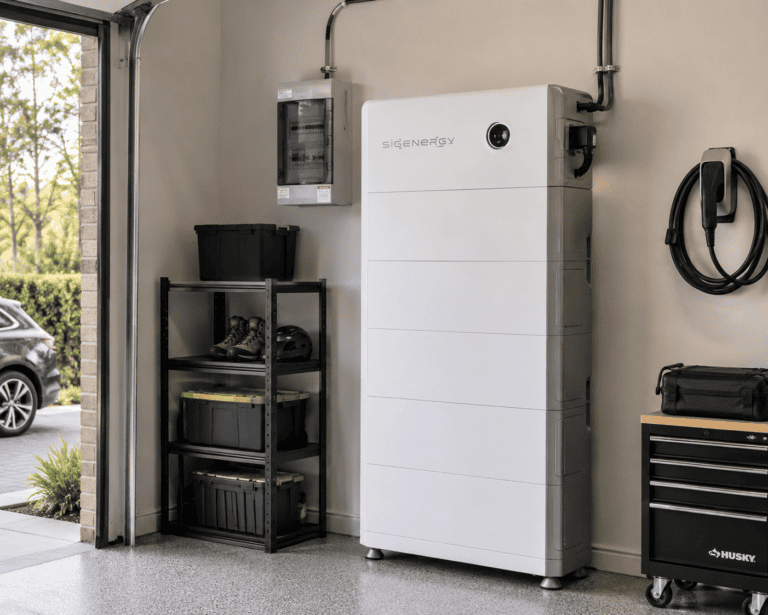
For households with existing solar, a battery stops you from exporting cheap and buying expensive. It captures your surplus solar generation during the day and makes it available when the sun isn’t shining.
A typical household saves $1,400–$2,100 annually with a solar battery in 2026. Battery payback periods typically run 5–10 years, with the federal Cheaper Home Batteries Program rebate reducing upfront costs by $3,000–$5,000+ depending on battery size.
The battery question is really a separate decision from the solar question. Solar is worth it almost regardless of whether you add a battery. The battery question depends on your usage patterns, evening consumption, and whether the rebate timing works for you.
See our full guide to the [Cheaper Home Batteries Program 2026] for current rebate details.
When Solar Is NOT Worth It
Being honest matters here. Solar doesn’t make sense for everyone:
Your electricity bill is very low. If you’re spending under $150–$200 per quarter on electricity, your consumption is too low to generate meaningful savings. The system cost won’t pay back in a reasonable timeframe.
You’re renting and can’t install panels. This is changing slowly with community solar schemes, but for most renters, rooftop solar isn’t an option.
Your roof has major shading issues. Trees, nearby buildings, or awkward roof orientation can cut system output by 20–40%. Get a site assessment before committing.
You’re planning to move within 3 years. Solar does add value to properties — Australian data shows homes with solar sell for roughly 2–3% more on average — but the payback maths get tighter if you’re not there for the full period.
Your roof needs replacing soon. If you’ll need to re-roof within 5 years, factor in the cost of removing and reinstalling panels (typically $800–$2,000) before committing.
What Affects Your Actual Savings
The state-level numbers above are averages. Your actual savings depend on:
Self-consumption rate. Without a battery, most households self-consume 25–35% of their solar generation. With a battery, this rises to 75–90%. Higher self-consumption means higher savings.
When you use electricity. Running appliances during daylight hours dramatically improves your solar economics. A household that uses most of its power at night gets less value than one that shifts consumption to solar generation hours.
Your electricity tariff. Time-of-use tariffs (which charge different rates at different times of day) can work in your favour or against you depending on when you consume power. Getting the right tariff for your usage pattern is worth a conversation with your retailer after installation.
System quality and design. A correctly sized system for your consumption profile will outperform an oversized or undersized one. Get at least three quotes and make sure each installer has reviewed your actual electricity bills.
The STC Rebate — Why Acting Sooner Matters
The federal STC rebate for solar panels is phasing down toward 2030. In 2026, the upfront discount on a 10kW solar system is roughly $400–$500 lower than in 2025, and it will decrease again on 1 January 2027. The scheme doesn’t disappear overnight, but waiting costs you rebate value.
The scheme phases down toward 2030, so the discount available today is higher than it will be in coming years. That makes 2026 a practical window, not an arbitrary one.
The Bottom Line
For the vast majority of Australian homeowners spending more than $400/quarter on electricity, solar is worth it in 2026. The payback period of 3–6 years against a 25-year panel warranty represents a strong return. Rising grid electricity prices make the economics more compelling every year, not less.
The key shifts from previous years:
- Value comes from self-consumption, not feed-in tariffs
- Battery storage has become a mainstream financial decision, not a luxury add-on
- The STC rebate is declining — earlier action locks in more value
For households on the fence, the practical question is whether your roof, your consumption, and your electricity bill justify a system. Get three quotes, ask installers to model your specific usage, and compare the numbers. Most people who do the maths find the answer is straightforward.
Frequently Asked Questions
Is solar worth it if I work from home? Yes — working from home typically increases daytime consumption which is exactly when solar is generating. This improves your self-consumption rate and payback period.
Does solar add value to my property? Yes. Australian property data consistently shows homes with solar sell for more. The premium varies by location and system quality, but 2–3% above comparable properties is commonly cited.
Should I wait for better technology? Solar panel efficiency improvements are incremental and won’t dramatically change the economics. Battery technology is improving, but the current generation of batteries is already cost-effective with rebates. Waiting primarily costs you rebate value and years of savings.
What size system do I need? A rough starting point: divide your average daily electricity usage (in kWh, found on your bill) by 4 to get a minimum system size in kW. Most Australian homes suit a 6.6kW system well.
Prices and savings estimates reflect 2026 Australian market conditions. Actual savings depend on your specific electricity usage, roof orientation, tariff structure, and location. Always obtain multiple quotes before committing.