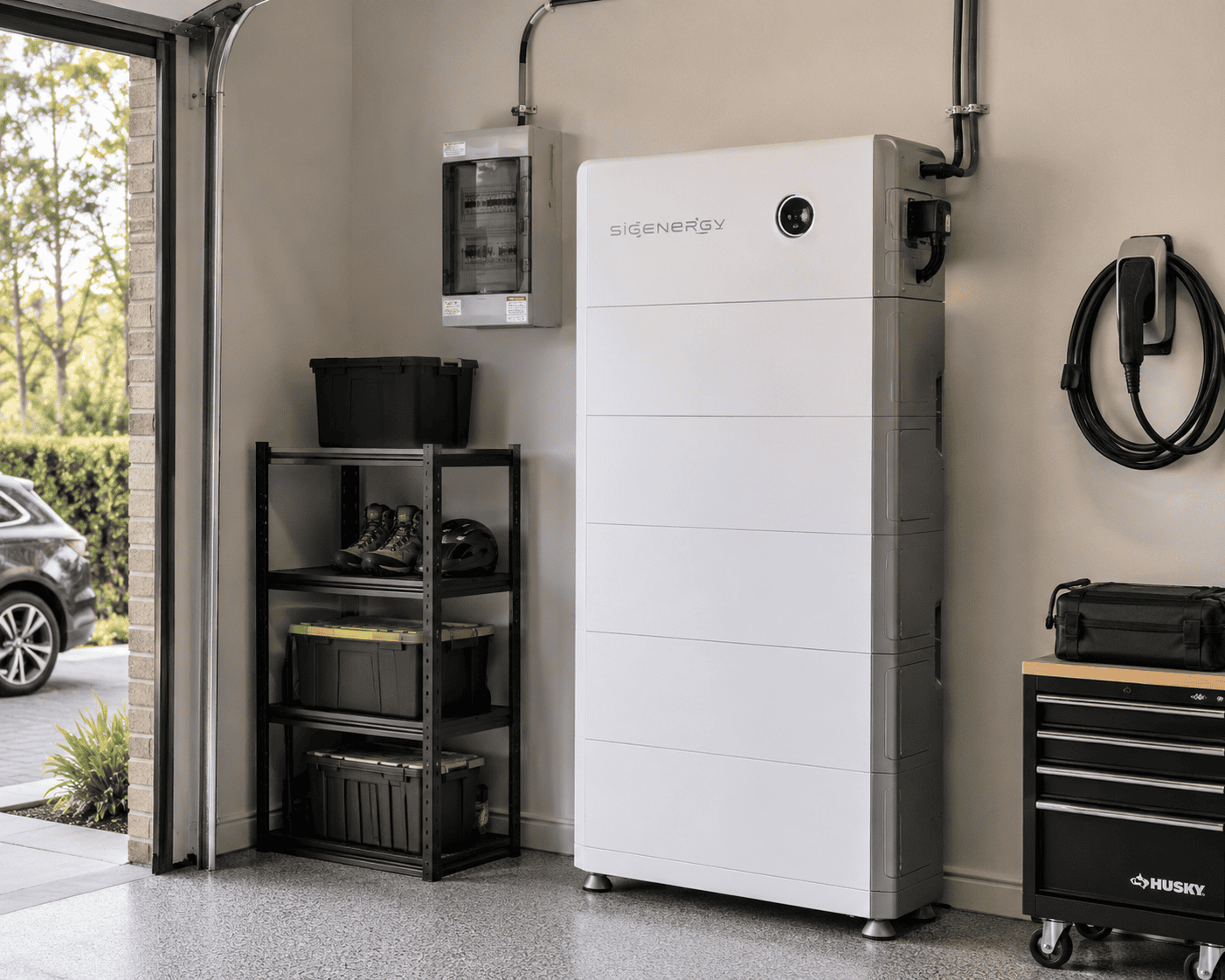
How Much Does a Solar Battery Save You Per Year? Real Australian Numbers
The honest answer to “how much will a solar battery save me?” is: it depends. But “it depends” isn’t useful without knowing what it depends on. This guide gives you the real numbers — by state, by household size, and by usage pattern — so you can run your own calculation.
The Short Answer
For a typical Australian household with existing solar panels adding a 10 kWh battery in 2026:
- Annual savings from the battery alone: $1,000–$2,100 per year
- Payback period: 5–10 years after the federal rebate
- Lifetime savings (15 years): $12,000–$25,000+
Australian households save $1,400–$2,100 annually with solar batteries in 2026 by storing cheap solar energy worth 4–7c/kWh if exported and avoiding expensive grid electricity at 35–48c/kWh.
Those are averages. Your number depends on five factors covered below.
Why Batteries Save Money: The Core Maths
Understanding why batteries save money makes the numbers easier to trust.
Without a battery, surplus solar electricity you don’t use immediately gets exported to the grid. Your retailer pays you a feed-in tariff — currently 3–10c/kWh in most states.
When the sun goes down, you buy electricity back from the grid at 30–45c/kWh.
With average grid electricity prices now around 38c/kWh and feed-in tariffs remaining low at roughly 5c/kWh, every kilowatt-hour you store and use yourself is worth seven times more than the energy you sell back to the retailer.
A battery intercepts that cheap surplus solar energy before it gets exported, stores it, and makes it available when your grid import rate is highest — typically evenings and early mornings.
Five Factors That Determine Your Savings
1. Your self-consumption rate
Without a battery, most households self-consume 25–35% of their solar generation — meaning 65–75% gets exported at the low feed-in tariff. A well-matched battery can push self-consumption to 75–90%.
The jump from 30% to 85% self-consumption is where most of the battery’s savings come from.
2. Your grid electricity price
The higher your electricity rate, the more each stored kilowatt-hour is worth. South Australian and NSW households on rates of 40–48c/kWh see the strongest battery savings. Tasmanian households on lower rates see more modest returns.
3. Your evening consumption
A battery is most valuable when your evening electricity usage is high. Households that cook, run air conditioning, and use appliances heavily in the evening have more to gain than households where most consumption happens during daylight hours.
4. battery size vs your usage
An undersized battery fills up during the day and can’t cover your evening needs. An oversized battery never fully charges and its capacity goes to waste. The sweet spot is a battery that covers your average evening load — typically 8–12 kWh for a 3–4 bedroom home.
5. Whether you participate in a VPP
Virtual Power Plant programs pay premium rates for battery exports during peak grid demand periods. Adding a battery to existing solar generates an extra $800–$1,500 on top of what your solar is already saving you. VPP participation can add $200–$500 per year on top of that in some programs.
Savings by Household Size
Based on a 10 kWh battery, 2026 Australian average electricity rates, and typical usage patterns:
| Household | Evening usage | Est. annual battery savings |
|---|---|---|
| 1–2 person apartment/unit | 4–6 kWh | $600–$900 |
| 2–3 person home | 7–10 kWh | $900–$1,400 |
| 3–4 person home | 10–15 kWh | $1,200–$1,800 |
| 4–5 person home | 15–20 kWh | $1,600–$2,200 |
| Large home / EV charging | 20kWh+ | $2,000–$3,000+ |
Households with electric vehicles charging overnight see the most dramatic battery savings because EV charging represents a large, predictable overnight load that a battery can cover instead of the grid.
Savings by State
Electricity rates vary significantly by state, which drives different battery economics:
| State | Typical grid rate | Typical feed-in tariff | Annual savings (10 kWh battery, avg household) |
|---|---|---|---|
| NSW | 30–38c/kWh | 5–10c | $1,200–$1,900 |
| VIC | 28–35c/kWh | 3–8c | $1,000–$1,600 |
| QLD | 28–33c/kWh | 8–12c | $900–$1,500 |
| SA | 38–48c/kWh | 3–10c | $1,500–$2,500 |
| WA | ~30c/kWh | 2.25–10c (DEBS) | $1,200–$2,000 |
| TAS | ~28c/kWh | 8–10c | $800–$1,200 |
| ACT | 25–28c/kWh | Regulated | $800–$1,300 |
South Australia consistently shows the strongest battery economics because the gap between the grid import rate (among Australia’s highest) and the feed-in tariff is the widest. Every stored kilowatt-hour saves the most money there.
Queensland shows lower savings in some scenarios because its regulated feed-in minimum (8.782c/kWh) is the highest on the mainland — meaning the opportunity cost of exporting is lower than elsewhere.
Savings by Battery Size
Not all batteries are the same size. Savings scale with capacity but not linearly — a larger battery saves more only if your household has the evening consumption to use it:
| Battery size | Best suited to | Est. annual savings |
|---|---|---|
| 5–7 kWh | Small household, low evening use | $500–$900 |
| 10 kWh | Average 3–4 bedroom home | $1,000–$1,800 |
| 13.5 kWh (Powerwall 3) | Larger home, some EV charging | $1,200–$2,200 |
| 15–20 kWh | Large home, regular EV charging | $1,800–$3,000 |
When paired with a typical solar system and smart energy management, a 10 kWh battery can save homeowners $1,000–$1,100 per year, with a payback period of 5–7 years even shorter if eligible for rebates.
The Impact of the Federal Rebate
The federal Cheaper Home Batteries Program significantly improves battery economics by reducing the upfront cost. For a 10 kWh battery, the rebate is approximately $3,000–$3,700. For a 13.5 kWh Powerwall 3, approximately $3,367.
This directly shortens your payback period. A battery that might take 8 years to pay back without the rebate might take 5–6 years with it. See our complete guide to the Cheaper Home Batteries Program 2026 for current rates and eligibility.
How to Estimate Your Specific Savings
The most accurate way to estimate your battery savings is to work through these steps:
Step 1 — Find your average daily solar export Look at your electricity bills. Most bills show your daily solar export in kWh. If not, your solar monitoring app will show it. For most 6.6 kW systems, daily export is 5–15 kWh depending on season and consumption.
Step 2 — Find your average evening consumption Your bill also shows your total daily consumption. Subtract what you use during daylight hours (typically 30–40% of daily total without a battery) to estimate your evening load.
Step 3 — Calculate the savings opportunity Each kWh of evening consumption you can cover from stored solar saves you approximately: grid import rate minus feed-in tariff. At 35c grid rate and 6c FiT, that’s 29c per kWh.
Step 4 — Multiply by your annual opportunity If you can cover 8 kWh of evening consumption from stored solar every day: 8 kWh × 29c × 365 days = $847/year. That’s the floor. Add any VPP participation income above that.
When a Battery Won’t Save You Much
Batteries are not right for every situation. You’ll see limited savings if:
- Your solar system is already undersized and you’re not generating meaningful surplus to store
- You’re rarely home in the evenings and your evening consumption is very low
- Your feed-in tariff is already high — in some Queensland and Tasmania plans, exporting at 10c+ reduces the opportunity cost of not storing
- Your electricity bill is under $200/quarter — the savings won’t justify the investment
What About Battery + Solar Together?
If you’re starting from scratch without solar, the economics change. The battery savings described above assume you already have solar panels generating surplus energy to store.
A standard 6.6kW solar system saves a typical family $1,200–$1,900 per year. Adding a battery captures an extra $800–$1,500 on top of what the solar alone saves.
A combined solar and battery system therefore typically saves $2,000–$3,500 per year for an average household — making the total investment more justifiable despite the higher upfront cost.
Frequently Asked Questions
Does a battery save money if I have a high feed-in tariff? Less so. The higher your feed-in tariff, the lower the opportunity cost of exporting rather than storing. If you’re on a Queensland plan paying 12c feed-in, every kWh you store is only saving you 12c × (35/12 – 1) = ~18c more than exporting. Still positive, but less dramatic than states with 3–5c feed-in tariffs.
How does weather affect my savings? Battery savings are lower in winter because lower solar generation means less surplus to store. Annual savings figures typically average across seasons. If you’re in a sunnier state like QLD or SA, seasonal variation is less pronounced.
Does a battery affect my feed-in tariff rate? No — your feed-in tariff is set by your electricity plan, not by your equipment. Adding a battery doesn’t change the rate your retailer pays for surplus exports.
What’s the difference between savings and payback? Savings are what you avoid paying each year. Payback is how many years of savings it takes to recover your upfront investment. A battery saving $1,500/year against a $9,000 net cost (after rebate) has a payback of 6 years. After that, the savings are effectively profit.
Savings estimates based on 2026 Australian electricity rates and typical household consumption patterns. Individual results will vary based on your specific usage, tariff, roof, and solar system.