N-Type vs PERC Solar Panels: Which Should Australians Buy in 2026?
Choosing between N-type vs PERC solar panels in Australia in 2026 is the question most homeowners are asking — and the market has shifted enough that the answer is now clearer than it’s been in years.
If you’ve been getting solar quotes in 2026, you’ve probably heard installers mention N-type panels — sometimes called TOPCon, HJT, or just “the new technology.” Most quotes from a year or two ago specified PERC panels. Now the market has shifted and the choice between the two is the most common question Australian solar buyers are asking.
This guide explains the difference in plain terms, why it matters for Australian conditions specifically, and whether the premium for N-type is justified for your situation.
The Short Answer
For most new Australian solar installations in 2026, N-type panels are worth choosing over PERC at current price premiums — which have narrowed to the point where the performance advantage justifies the cost difference for most households.
That said, PERC panels are not bad. A quality PERC panel from a reputable Tier 1 manufacturer will still perform well for 25 years. The question is whether the incremental improvement from N-type is worth the incremental cost — and in 2026, for most Australians, it is.
What PERC Actually Is
PERC stands for Passivated Emitter and Rear Cell. It’s been the dominant residential solar technology globally for the past decade.
A PERC panel adds a passivation layer to the rear of a standard P-type silicon cell. This layer reflects light that would otherwise pass through the cell back for a second absorption pass, improving efficiency. Standard PERC panels achieve efficiencies of 20–21.5%, which is a meaningful improvement over the basic P-type cells they replaced.
PERC panels are well-understood, widely available, and manufactured at massive scale — which is why they became the default residential choice and why their price fell so dramatically through the 2010s and early 2020s.
What N-Type Actually Is
N-type refers to the base silicon used in the cell — doped with phosphorus rather than boron (which creates P-type silicon). The practical consequence of this difference is significant:
Less degradation from light exposure. P-type silicon suffers from Light Induced Degradation (LID) — the panel loses a small percentage of output in its first few hours of sunlight exposure. N-type silicon does not experience LID, meaning N-type panels start at their rated capacity and stay there.
Better performance in heat. N-type panels have a lower temperature coefficient — they lose less output as temperature rises. This matters significantly in Australian conditions.
Longer useful life. N-type panels degrade more slowly over their lifetime, producing meaningfully more electricity in years 15–25 than equivalent PERC panels.
The three main N-type technologies you’ll encounter in Australian quotes:
TOPCon (Tunnel Oxide Passivated Contact) — most common in 2026. Used by Trina, Jinko, LONGi, and many others. Achieves 22–23% efficiency at competitive prices.
HJT (Heterojunction Technology) — used by REC and some Panasonic/HIT products. Achieves the best temperature coefficient of any mainstream technology. More expensive than TOPCon.
IBC/ABC (Back Contact) — used by SunPower (Maxeon) and Aiko. Highest efficiency available, premium price. Back contacts eliminate shading losses from front-side busbars.
The Comparison That Matters for Australian Conditions
Efficiency
| Technology | Typical efficiency range |
|---|---|
| PERC | 20.0–21.5% |
| N-type TOPCon | 22.0–23.0% |
| HJT | 22.0–23.5% |
| IBC/ABC | 23.0–25.2% |
Higher efficiency means more electricity from the same roof space. For a standard 6.6 kW system, moving from 20.5% PERC to 22.5% TOPCon panels means you can fit the same system into approximately 10% less roof area — or generate 10% more electricity from the same area.
Temperature Performance
This is where Australian conditions make N-type’s advantage most pronounced. The temperature coefficient measures how much output falls for every degree above 25°C (standard test conditions).
| Technology | Typical temperature coefficient |
|---|---|
| PERC | -0.35% to -0.40%/°C |
| N-type TOPCon | -0.30% to -0.35%/°C |
| HJT (e.g. REC Alpha) | -0.24% to -0.26%/°C |
On a 45°C summer day in Adelaide or Perth — common conditions — a roof surface temperature might reach 65°C, meaning 40°C above standard test conditions.
At -0.40%/°C (typical PERC): output falls by 16% At -0.30%/°C (typical TOPCon): output falls by 12% At -0.24%/°C (HJT): output falls by 9.6%
That difference is real electricity you either generate or don’t during the hottest parts of Australian summer — precisely when your air conditioning is drawing the most power.
Degradation Over 25 Years
Long-term degradation is where the compounding advantage of N-type becomes most significant.
| Technology | Typical annual degradation |
|---|---|
| PERC | 0.45–0.55%/year |
| N-type TOPCon | 0.25–0.35%/year |
| HJT | 0.25–0.30%/year |
Over 25 years, a PERC panel degrading at 0.50%/year retains approximately 88% of original output. An N-type TOPCon panel degrading at 0.30%/year retains approximately 93%. That 5% difference in year 25 output is cumulative — the N-type panel has produced more electricity every single year.
Price Difference in 2026
This is where the decision has become clearer than in previous years. The price premium for N-type TOPCon over quality PERC has narrowed significantly.
| Technology | Approximate cost per watt (supply only) |
|---|---|
| Quality PERC (e.g. Canadian Solar) | ~$0.22–$0.25/W |
| N-type TOPCon (e.g. Trina Vertex S+, Jinko Tiger Neo) | ~$0.26–$0.30/W |
| HJT (e.g. REC Alpha) | ~$0.32–$0.38/W |
| IBC/ABC (e.g. SunPower, Aiko) | ~$0.40–$0.55/W |
For a 6.6 kW system, moving from quality PERC to N-type TOPCon adds approximately $250–$400 to the panel supply cost. Over 25 years, the additional electricity generation from better efficiency, lower temperature coefficient, and slower degradation typically exceeds this cost difference significantly.
The premium for HJT is larger — approximately $600–$900 more for a 6.6 kW system — but is more justifiable in climates with frequent extreme heat (Darwin, Perth, inland Queensland, Adelaide in summer).
Which Should You Choose?
Choose N-type TOPCon if:
- You want the best performance-to-cost ratio in 2026
- You’re in a warm climate (most of Australia qualifies)
- Your roof has some shading or suboptimal orientation and you want to maximise output from available panels
- You’re planning a combined solar + battery installation and want to maximise generation
Choose HJT (e.g. REC Alpha) if:
- You’re in a very hot climate — Darwin, Perth, coastal QLD, inland SA
- Temperature performance matters more than any other factor
- You’re willing to pay a modest premium for the best heat tolerance available
Quality PERC is still acceptable if:
- You’re in a cooler climate (Tasmania, southern Victoria) where temperature coefficient matters less
- Budget is genuinely the primary constraint
- You’re choosing a reputable Tier 1 brand with a 25-year performance warranty
Avoid: Unknown or unverifiable panel brands regardless of technology. A low-quality N-type panel from an unproven manufacturer is worse than a quality PERC panel from a reputable Tier 1 brand.
The Installer Question
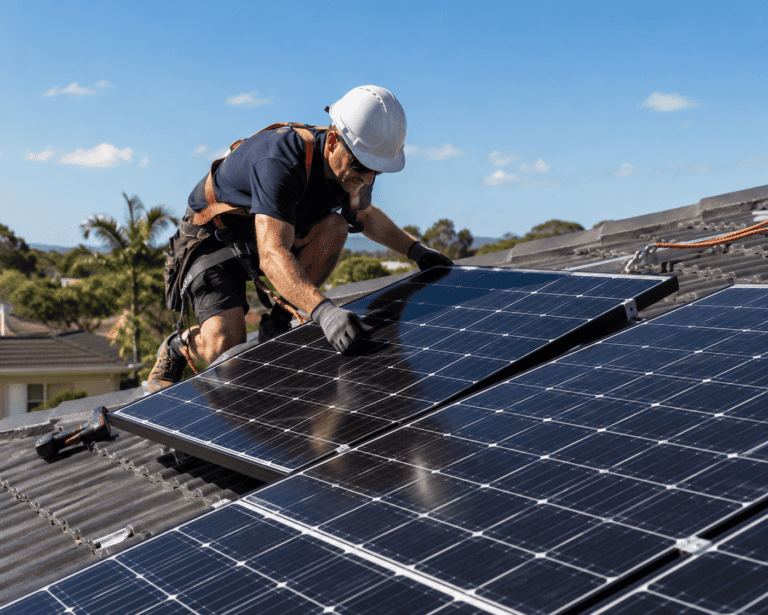
Most reputable Australian solar installers now default to N-type TOPCon panels for new residential installations in 2026. If your installer is quoting PERC panels without explaining why, it’s reasonable to ask whether N-type alternatives are available at similar pricing.
That said, don’t let panel technology become a distraction from the more important question: is this a reputable, SAA-accredited installer with strong local references? A great installer with PERC panels will outperform a poor installer with premium N-type panels over a 25-year system life.
Frequently Asked Questions
Will PERC panels still perform well for 25 years? Yes — quality PERC panels from reputable Tier 1 manufacturers will still produce good output for 25 years. The question is whether they produce as much as N-type over that period. For most Australian conditions, they won’t — but the difference is meaningful rather than dramatic.
Is TOPCon the same as N-type? TOPCon is one type of N-type cell technology. All TOPCon panels are N-type, but not all N-type panels are TOPCon — HJT and IBC are also N-type. TOPCon is the most common N-type technology in the Australian residential market in 2026.
Do warranties differ between PERC and N-type? Most panels of both types offer 25-year performance warranties from reputable manufacturers. Some N-type panels (LONGi HiMO X6, SunPower Maxeon) offer 30-year or even 40-year performance warranties, reflecting confidence in their lower degradation rates.
Are there any downsides to N-type panels? The main downside is cost — though the premium has narrowed significantly in 2026. Some early TOPCon panels showed higher degradation than initial specifications suggested, but this has largely been resolved in current production from established manufacturers. Stick to brands with established Australian track records.
Panel specifications and pricing reflect the Australian market as at September 2026. Technology improvements are ongoing — confirm current model specifications with your installer.